DAUGHTERS AT RISK
Nigeria's Trafficked Girls Are Telling Their Stories on TikTok. Now It Is Time to Use Those Stories to Build the Solutions That Stop It.
Thank you for subscribing
Thank you for subscribing
Thank you for subscribing
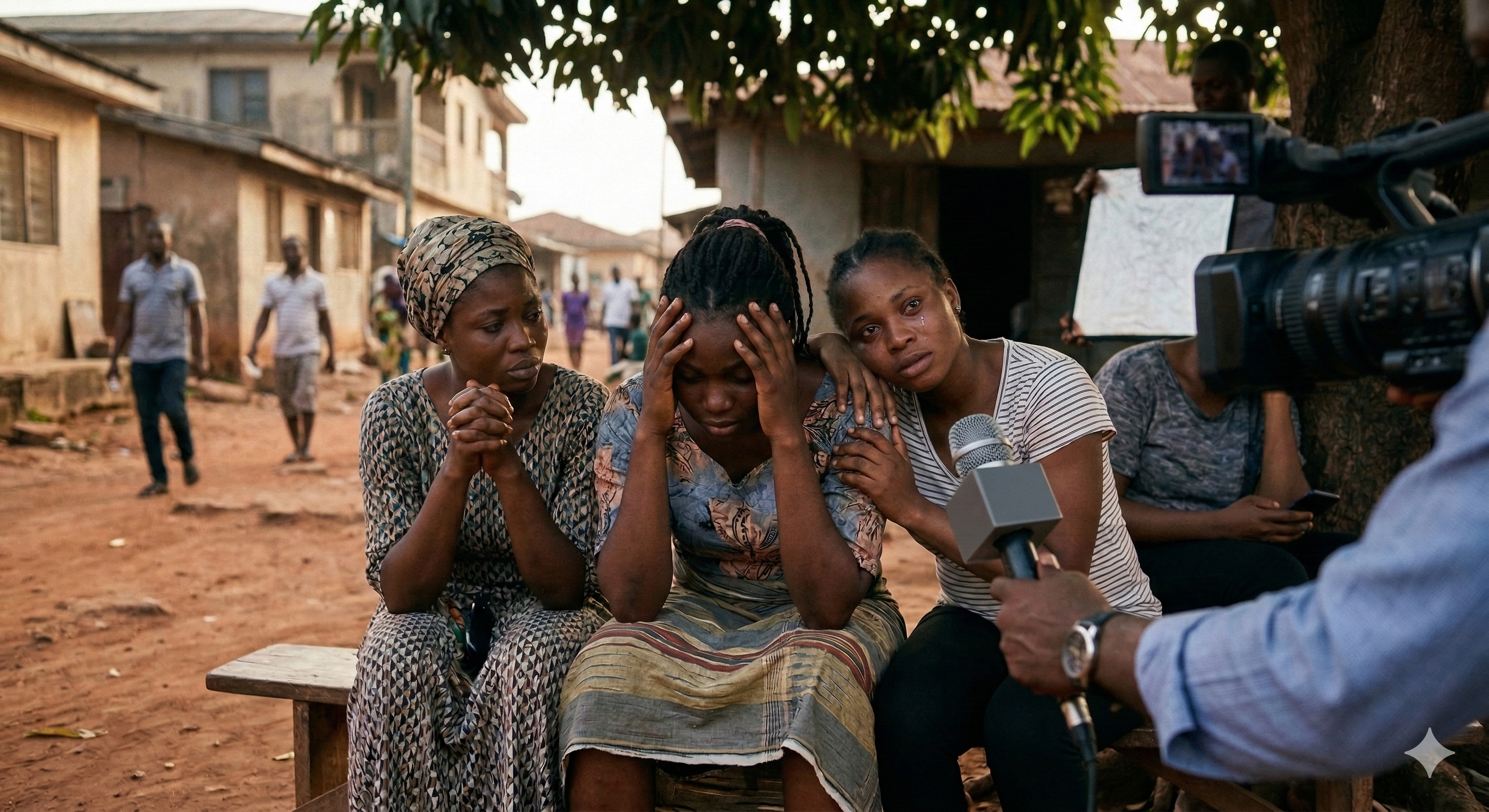
I open TikTok not with any particular intention, not searching for anything specific and within minutes, a story pops up. A young woman, face half-lit by a phone screen, voice measured and careful the way voices go when they are carrying something too heavy to rush. She is from Edo. Or Imo. Or Anambra. She is describing a woman she trusted, a promise she believed, a bus she boarded, a boat she did not know she would be forced onto. She is describing what happened after.
I scroll. Another one appears, then a woman recording from what appears to be a shelter, speaking in careful fragments, as if she is still deciding how much of the story she is allowed to tell.
This is my TikTok experience now. Not once a week. Not occasionally. Daily. Multiple times a day. And I have spoken to enough people to know I am not alone in this. These testimonies are surfacing in feeds across Nigeria, across the diaspora, across the world, carried by an algorithm that does not know what it is distributing and does not particularly care.
I want to point out something important before going any further: the courage of these women is extraordinary. They are not activists by training. They did not sign up to be the faces of a crisis. They are telling their stories because the courts failed them, because the police dismissed them, because their communities sometimes shamed them, and because the TikTok platform which is commercial and algorithmically indifferent, is the only space that will hold their voices and put them in front of an audience. That is both a tribute to their resilience and an indictment of every institution that should have served them and did not.
"I told my story three times to different agencies. Nobody did anything. When I posted on TikTok, ten thousand people watched in one day. That was the first time I felt like someone heard me." — Anonymous survivor, Lagos, 2025
But here is the thing about all those testimonies accumulating in our feeds, they are not just stories. They are data. They are real-time intelligence about a crisis that Nigeria's formal systems are failing to contain. If we are willing to receive them as such, to treat the flood of survivor accounts not as content to consume and scroll past, but as evidence to be gathered, mapped, and acted upon, then the very digital platforms that have enabled this exploitation also hold the infrastructure for one of the most powerful responses to it ever attempted.
The stories are not the problem. The stories are the beginning of the solution. The question is whether we have the discipline, the political will, and the institutional capacity to use them.
When you listen to enough of these accounts, not just as individual testimonies but as a pattern, certain things emerge with striking consistency. The same phrases. The same sequences. The same moments where the trap closes. This is not a coincidence, it is the fingerprint of an organised system.
Almost every story begins with a woman, usually older, usually known to the family or the community, who arrives with a proposition. She has a contact in Italy, or in Libya, or in Burkina Faso. There is work that involves cleaning, cooking, and caring for children. The salary is specific and credible. The story is detailed and checked. Sometimes there is documentation. The family is reassured. The girl believes. She leaves.
Then the sequence changes, the job does not exist. The debt appears and is usually fabricated, enormous, impossible to repay. The passport disappears. The phone disappears. Physical violence establishes the new terms of the relationship. Whereas, somewhere between Lagos and Benin City and Agadez and Tripoli, a girl who believed a woman she trusted discovers that trust was a weapon and she is now property.
These patterns are not new. What is new is that survivors are narrating them publicly, in detail, in real time, on a platform with 37.4 million Nigerian users. That has never happened before at this scale. And it creates a possibility that did not exist a decade ago and that is the systematic capture of survivor intelligence to drive prevention, protection, prosecution, and policy all at once.
Source: Krestel Digital Social Media Statistics Nigeria 2025 · TechNext24 November 2025 · UK Home Office CPIN Nigeria 2022
The personal accounts on TikTok are not isolated tragedies. They are the visible surface of a documented, quantified, state-by-state crisis that Nigeria's own data has captured in extraordinary detail. The numbers do not make the stories more real, the stories are always real but they make denial impossible.
Nigeria Is Not Merely Affected. Nigeria Is Ground Zero.
According to the U.S. State Department's 2025 Trafficking in Persons Report, Nigeria identified and provided services to 2,058 trafficking victims in a single reporting period, up from 1,194 the previous year. Of those, 1,076 were sex trafficking victims. Over 76 percent of all identified victims were female. NAPTIP has rescued more than 20,000 victims in its 22-year history. And those are only the cases the system could see.
trafficking victims identified in Nigeria in one reporting period
(76% female)
total victims rescued by NAPTIP in 22 years
investigated in 2024 — down sharply from 1,242 the year before
of victims rescued from external sex trafficking by NAPTIP are from Edo State (UNODC)
The drop in investigations from 1,242 to 698 in one year is not evidence that trafficking declined. It is evidence that the investigative apparatus weakened. In the same period, five NAPTIP staff members, including a deputy director, were dismissed for complicity in trafficking. One Nigerian Immigration Service officer was prosecuted for sex trafficking. Endemic corruption within the very system built to protect victims is at the epicentre of the story.
There is an uncomfortable truth that nobody in the anti-trafficking space wants to fully sit with and it is that TikTok is simultaneously the most dangerous recruitment tool traffickers in Nigeria are currently using, and the most powerful awareness and mobilisation platform available to those trying to stop them. It is not one or the other. It is both. And the response to that duality cannot be to simply condemn the platform and walk away. It has to be to fight for control of it.
Nigeria is TikTok's fastest-growing major market in Africa. Between 2024 and 2025, Nigeria added 13.56 million new users(a 56.9 percent increase) bringing the total to 37.4 million people. That is a larger audience than any Nigerian television network has ever reached, and it is an audience skewed heavily toward young women aged 16 to 24: exactly the demographic that traffickers target.
37.4M TikTok users in Nigeria — growing 56.9% in one year
7.46M videos removed by TikTok Nigeria in H1 2025 — 41,000 per day
49,512 LIVE sessions banned in Nigeria in Q2 2025 for sexual exploitation violations
Recruiters do not post explicit solicitations. They operate in the language of aspiration. 'Aunty abroad needs a serious girl.' 'Travel opportunity: Europe, no experience needed.' 'Good salary, accommodation provided, DM for details.' These phrases circulate in Nigerian Pidgin, in Yoruba, (in Igbo) coded, culturally specific, invisible to English-language content moderation algorithms. A 17-year-old in Benin City sees it as a comedy skit and a dance trend and has no framework to identify it as a recruitment post. She DMs. The conversation moves to WhatsApp. She boards a bus. The story that will appear on TikTok two years later, if she survives to tell it, has already begun.
In December 2025, TikTok suspended its nighttime LIVE feature in Nigeria entirely after a surge in explicit sexual livestreams including real-time sex acts broadcast for virtual gifts. During a single quarter, the platform issued warnings and demonetised over 2.3 million LIVE sessions in Nigeria and penalised over one million Nigerian creators. Nigeria accounted for 49,512 banned LIVE sessions in Q2 2025 alone. These are not fringe numbers. They describe a platform where exploitation has gone mainstream, and where the company's enforcement, though accelerating, remains perpetually reactive.
"TikTok suspended access to its late-night LIVE feature in Nigeria following a surge in livestreams containing explicit sexual content, including cases of users engaging in real-time sex acts before large online audiences." — Vanguard News, December 2025
Yet,the same platform that carries recruitment posts also carries the testimony of every woman who survived what those posts led to. When a survivor describes her trafficker's recruitment method in a TikTok video, she is doing something that law enforcement agencies spend millions of dollars and years of investigation trying to do. She is describing, from the inside, exactly how the network operates. When ten survivors describe the same method independently, across different videos, recorded months apart, the pattern becomes investigable intelligence. When a hundred do, it becomes a map.
These stories are extraordinarily valuable and Nigeria can build the institutional infrastructure to capture, systematise, and act on them(If they are willing to sha!)
Source: TechNext24 November 2025 · Vanguard News December 2025 · Krestel Digital 2025 · Human Trafficking Institute 2025
The rise of survivor testimonies on social media platforms like TikTok has created a powerful digital signal about the scale and patterns of human trafficking in Nigeria. Instead of allowing these stories to remain moments of emotional reaction, they can be converted into tools for intelligence, accountability, and policy change.
Nigeria should establish a survivor intelligence database within the National Agency for the Prohibition of Trafficking in Persons (NAPTIP) to systematically analyse publicly shared survivor testimonies online. Coding these stories for recruitment methods, trafficking routes, and trafficker profiles could significantly improve investigations.
Civil society organisations should collectively build a unified digital platform that converts viral awareness into action. This would allow viewers to report trafficking, donate to survivor funds, contact policymakers, or join community watch groups.
Nigeria should introduce a digital platform exploitation levy, requiring tech platforms to contribute a percentage of their Nigerian advertising revenue to anti-trafficking efforts. This approach mirrors regulatory accountability measures found in the UK Online Safety Act 2023 and could be implemented through Nigeria’s Cybercrimes (Prohibition, Prevention, etc.) Act.
Survivors themselves should play a central role in policy design. Future anti-trafficking strategies developed by National Agency for the Prohibition of Trafficking in Persons should include formal survivor advisory councils, ensuring policies reflect the lived intelligence of those who have experienced trafficking.